
The 15 essential nutrients every crop needs
Three come free from air, water and sunlight. The rest come from the soil, and are the ones a grower can manage. Get the balance right and the plant does the rest.
Essential elements
Drawn from the environment, not the soil. The base of every plant process.
Macronutrients
The heavy lifters of growth, yield and structure.
Micronutrients
Small quantities, but crops fail without them.
Every nutrient and its deficiency symptoms
Tap any nutrient to open its symptoms, the South African crops it affects most, and the Zylem products that correct it.

Stunted growth and an overall pale, light green to yellowish colour. The oldest, lower leaves yellow first, often in a V-shape from the leaf tip, and leaves may stand unusually upright.
Maize and wheat show the classic V-shaped yellowing on older leaves. Nitrogen is one of the first things to limit early-season growth on Highveld grain lands.
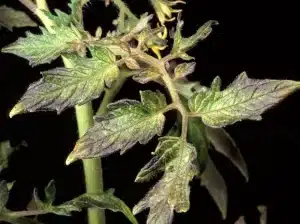
Dull, dark blue-green leaves that develop purple or reddish-bronze tints, most obvious on older leaves and stems. Growth is stunted and maturity is delayed.
Purpling in young maize is widespread on cold, acidic, phosphorus-fixing Highveld soils, and low phosphorus also holds back soya bean establishment.

Yellowing and browning (scorch) along the margins and tips of the older leaves. Small spots appear near the leaf tips, turn rusty, and the edges begin to fold or curl inward.
Potatoes and maize are heavy potassium feeders, and marginal scorch on the older leaves is a frequent late-season sight when demand outstrips supply.
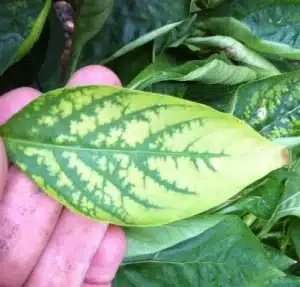
Interveinal yellowing that spreads inward from the leaf margins on the older leaves, while the veins stay green. Edges form cup-shaped folds and, in severe cases, leaves die.
Common on sandy, acidic and heavily limed soils. It turns up in maize, potatoes and soya on leached KwaZulu-Natal and Highveld lands.
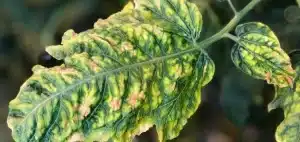
Whole leaves turn light green, lemon, yellow or orange, with mottling over the blade except the veins, and older leaves go first. In legumes, nitrogen fixation and nodulation fail.
Poor nodulation and pale, stunted soya beans and other legumes on acidic soils are the tell-tale molybdenum sign in South Africa.
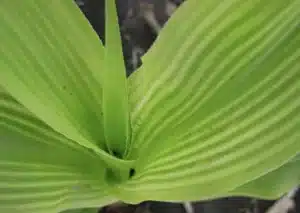
Uniform paling and yellowing of the youngest leaves first, while the older leaves stay greener, the reverse of nitrogen. Growth becomes spindly and slow.
Increasingly seen in high-yield wheat and canola as atmospheric sulphur inputs decline and yields rise.
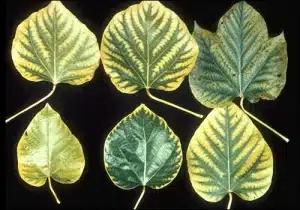
Pale younger leaves with a fine reticulated pattern: the veins and venules stay dark green while the tissue between them yellows. Grey or brown speckling can follow.
Manganese lock-up is common on over-limed, high-pH soils and affects soya bean, wheat and maize.
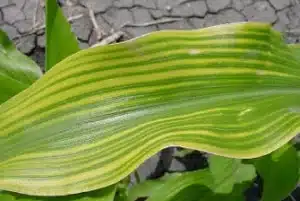
Small, narrow young leaves with pale interveinal tissue and short dark-green veins. Shortened internodes cause rosetting, with dark spots along the leaves and edges.
Zinc is one of the most widespread micronutrient limits in South African maize, on sandy, high-pH and eroded soils.
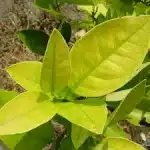
Sharp interveinal chlorosis on the youngest leaves: a fine network of green veins on a pale-yellow background, with no spots. Severe cases bleach almost white.
Iron chlorosis appears on high-pH, calcareous and waterlogged soils, and is common in citrus, deciduous fruit and vegetables.

Because calcium is immobile, symptoms strike the new growth: distorted, hooked or dying young leaves, die-back of growing tips, poor root tips, and disorders such as blossom-end rot and internal browning.
Blossom-end rot in tomatoes and potatoes, and tip disorders in intensively grown vegetables, are the classic calcium stories.

Death of the growing tips and buds, brittle and distorted new growth, thickened or corky stems and petioles, and buds that break off and drop.
Sensitive crops include sunflower, canola and lucerne, and hollow heart or brown centre in brassicas and potatoes signals low boron.

Wilting, pale new growth with a pale-pink colouration between the veins. Leaf tips die back, leaves may wilt and drop, and grain fill and pollination can be poor.
Copper shortfalls occur on sandy and high-organic (peaty) soils, and wheat and other small grains are especially sensitive.
More fertiliser is not the answer
Applying more product rarely fixes a deficiency and often makes the balance worse. The goal is the right nutrient, in the right amount, at the right time, delivered where the plant can use it.
Zylem supplies biological soil conditioners and foliar feeds that address deficiencies at the source: healthier soil biology unlocks nutrients already present, and targeted foliar feeds correct a shortfall fast when a crop is under pressure.
Test before you treat
A soil or leaf analysis tells you what is actually short, and what is present but locked up.
Feed the soil first
Living, biologically active soil releases nutrients naturally and keeps them available.
Correct fast with foliars
When a crop shows stress, a targeted foliar feed gets the missing nutrient in quickly.
Frequently asked questions