
Farm conditions & solutions

Solutions for drought in South African agriculture

The severity and frequency vary, but drought is a constant. We cannot make it rain, so we help your soil hold on to every drop it gets.

The challenge

Drought is a recurring reality, not a one-off

South African farmers face recurring drought cycles, sharpened in El NiƱo years, that threaten yields, cash flow and the long-term viability of the farm. Much of our maize, wheat, soya bean and dryland production depends on rainfall that arrives late, stops early, or never comes at all.

We cannot control the rain. What we can change, dramatically, is how much of it your soil captures and how slowly it releases that water back to the crop. That is where regenerative soil practice earns its keep.

170 000 L

of extra water per hectare that soil can hold for every 1% rise in organic matter.

Every drop

counts. Better structure means rain soaks in instead of running off the surface.

Try it

How much water can your soil bank?

Organic matter behaves like a sponge. Drag the slider to see roughly how much extra water a hectare of your soil can hold as you build organic matter. Based on the widely used rule of thumb of 170 000 litres per hectare for each 1% of organic matter.


2%

0.5% degraded
6% deep, living soil
340 000 L
Litres held per hectare
34 mm
Equivalent rainfall buffer
34
10 000 L water tankers

Illustrative figures to show the scale of the effect. Actual water-holding depends on soil texture, depth and structure. Book a soil analysis for numbers specific to your land.

How we help

Four ways healthy soil beats drought

Regenerative soil practice sits at the heart of drought resilience. Soils rich in organic matter and biology hold far more water, and release it more slowly to plant roots.

01

Improved water infiltration

Biologically active soils with good structure let water penetrate rather than run off, capturing every drop of rainfall.

02

Higher water holding capacity

Organic matter acts like a sponge. Every 1% increase lets a hectare hold an extra 170 000 litres of water.

03

Deeper root systems

Well-nourished plants develop deeper roots that reach subsoil moisture through the dry periods.

04

Reduced evapotranspiration

Soil cover and biological activity cut surface evaporation, keeping moisture in the root zone for longer.

Recommended products

Products for drought resilience

Three Zylem products that help crops make the most of limited water and recover after a dry spell.

Sea Brix pack shot

Sea Brix™

Supports photosynthesis efficiency, helping plants make the most of every drop of available water.

View product →

NanoCal pack shot

NanoCal

Calcium improves cell wall integrity, helping plants manage osmotic stress during dry periods.
View product →

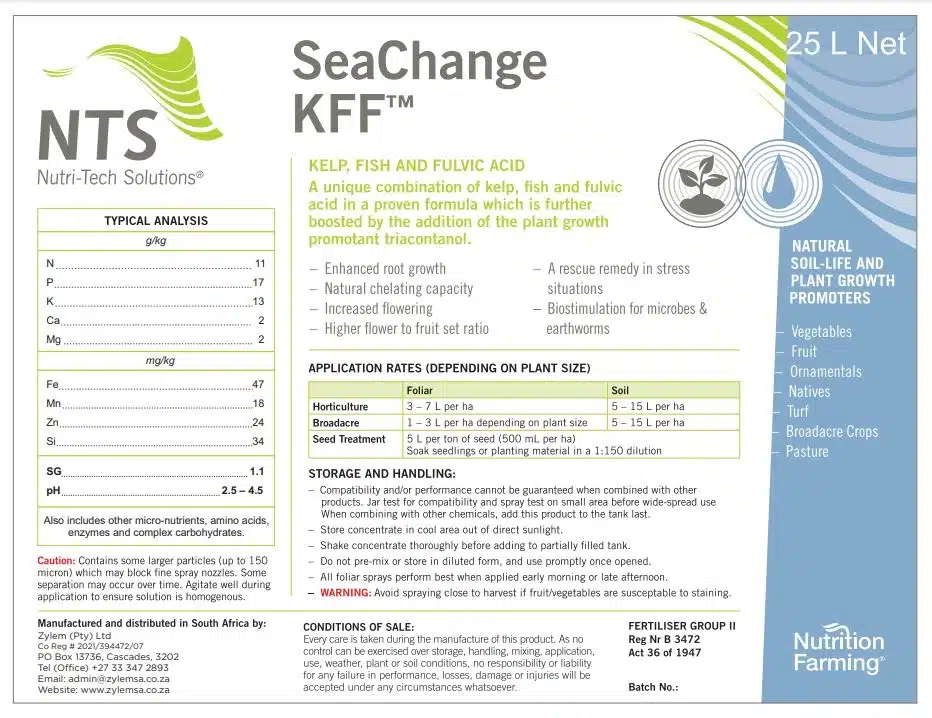
Sea-Change KFF pack shot

Sea-Change KFF™

A bio-stimulant and stress rescue remedy that supports plants during and after drought events.

View product →

Drought-smart practice

Practices that stack up over the season

Products work hardest alongside a resilient system. These practices build the organic matter and cover that keep water in your soil, on maize, wheat, soya bean, potato and other broadacre lands.

Keep the soil covered

Residue and cover crops shade the surface, slashing evaporation and keeping soil temperatures down.

Minimise tillage

Less disturbance protects soil structure and the pore spaces that let water infiltrate and store.

Build organic matter

Feed soil biology so organic matter climbs season on season, and with it your water buffer.

Support the plant under stress

Targeted bio-stimulants and calcium help crops hold condition through dry spells and bounce back after.

Talk to us

Get expert advice on drought management

Tell us about your soil, your crops and your rainfall, and our agronomists will help you build a drought-resilience plan that fits your farm.

+27 33 347 2893
Unit 20, 3 Cascades Crescent, Chase Valley, Pietermaritzburg, KZN, 3201